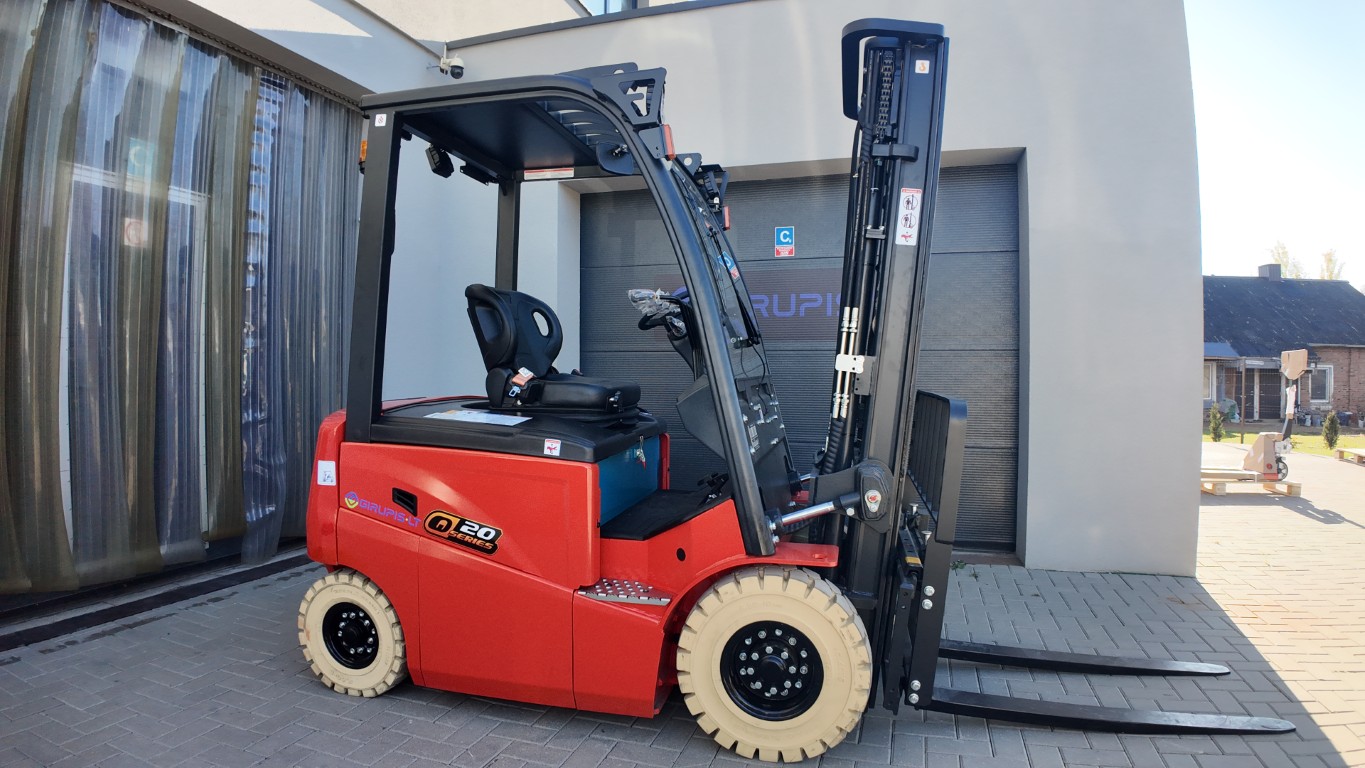
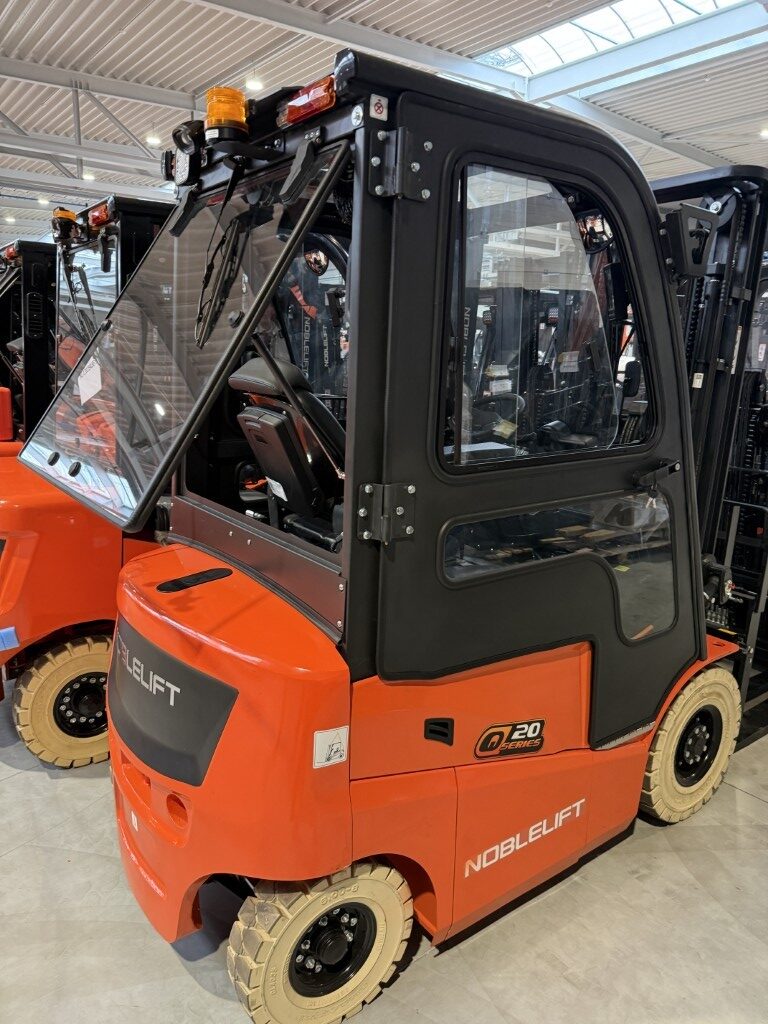
Description
Video of a similar forklift (3.0 tonnes):
MAIN ADVANTAGES
-
- AC TRACTION MOTORS THAT DO NOT REQUIRE SPECIALISED MAINTENANCE
The Q-Series has powerful and maintenance-free AC motors. Compared to traditional DC motors, Noblelift AC motors do not require the replacement of carbon brushes. They are equipped with speed and temperature sensors, which greatly improves the reliability of AC motors. - QUIET, LOW VIBRATION DESIGN
The hydraulic system uses a silent plunger pump and includes full hydraulic power steering. The system is quiet and easy to operate. The rear axle and at the same time the steering axle have a vibration-absorbing design (mounted in the body on large rubber cushions), i.e. the use of curved flexible joints, thus providing additional protection for the whole loader and extending the service life of the loader. - LOW CENTRE OF GRAVITY
The front axle (also the drive and braking axle) has a 2-stage horizontally mounted gearbox, The 2-stage gearbox has a high transmission coefficient so that the engine can run at higher speeds to get off the ground, requiring less energy to overcome inertia. On the other hand, the high gear ratio of the reducer allows the travel motor to run at higher speeds, whereas with AC motors, the higher the speed, the less energy the motor can use.The low weight is also contributed to by the battery mounted on the bottom of the frame, thus giving the forklift stability. - A FLEXIBLE LIFTING MECHANISM
Noblelift uses a classic jib design - a wide profile construction that accommodates large bearings. The boom sections have internal lateral stabilisers which have 2 functions: to improve the lifting performance at high altitudes and to reduce the natural wear on the boom. The lateral fork pushers and/or positioners are mainly used by CASCADE, a manufacturer that is very popular in this field and has earned a reputation as a reliable manufacturer.
- AC TRACTION MOTORS THAT DO NOT REQUIRE SPECIALISED MAINTENANCE
| Simple and convenient operation and excellent visibility | |
 |
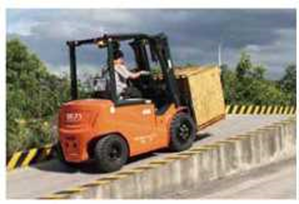 |
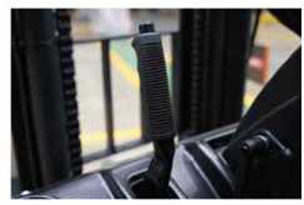
| The forklifts use a long parking brake handle for easy and reliable operation of the manual parking brake | This type of parking brake allows the forklift to safely stand on slopes up to 15 %! |
 |
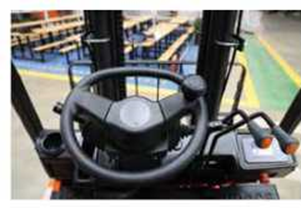 |
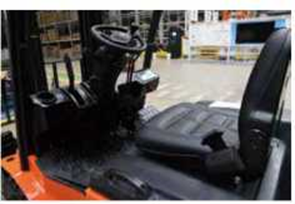
| They come with a fully shock-absorbing and adjustable seat, allowing the driver to adjust to the ideal driving position. | The sports-style steering wheel design with an additional steering wheel and front directional control knob makes steering the loader easy and comfortable |
|
|
 |
|
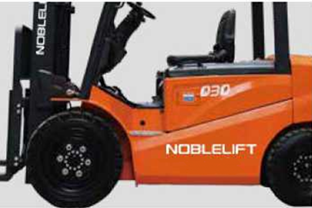
Good visibility on all sides of the boom (hidden hydraulic components, i.e. no obstruction of visibility). The t.p. forks slow down automatically just before touching the ground - thus protecting the load and the floor surface |
The simplified design is more practical while maintaining the strength and reliability of the frame
|
|
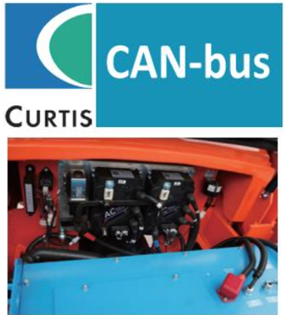
Another unique advantage is the use of advanced electric actuators („controllers“) that control both the travel and lift motors. The drives used are market reference, reliable and of high quality (e.g. CURTIS) - the market benchmark, If a lithium iron phosphate battery is used in a forklift truck, its diagnostics are carried out through the drive controllers. And since Noblelift also uses the CURTIS display, which allows for efficient setting changes, the lithium battery settings (such as operating temperature, permissible depth of discharge, etc.) can be changed as required.) via the same display, or to monitor battery parameters (such as cell balance, number of charge/discharge cycles, history of current magnitudes, energy consumption, temperature, charge/discharge parameters, voltage of each cell, faults and alarms, automatic shutdown time settings, etc.). In other words, the Q-Series is fully optimised and does not have any intermediate circuits or third-party adaptors in its electrical circuit and signal transmission - this is particularly important for lithium batteries, as very often lithium batteries have separate diagnostics, which makes it very difficult to maintain or repair the forklift. All this is not available on the Q-Series. |
|
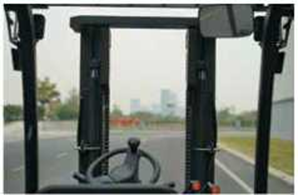
Drivers' compartment - spacious, ergonomic and suitable for tall people
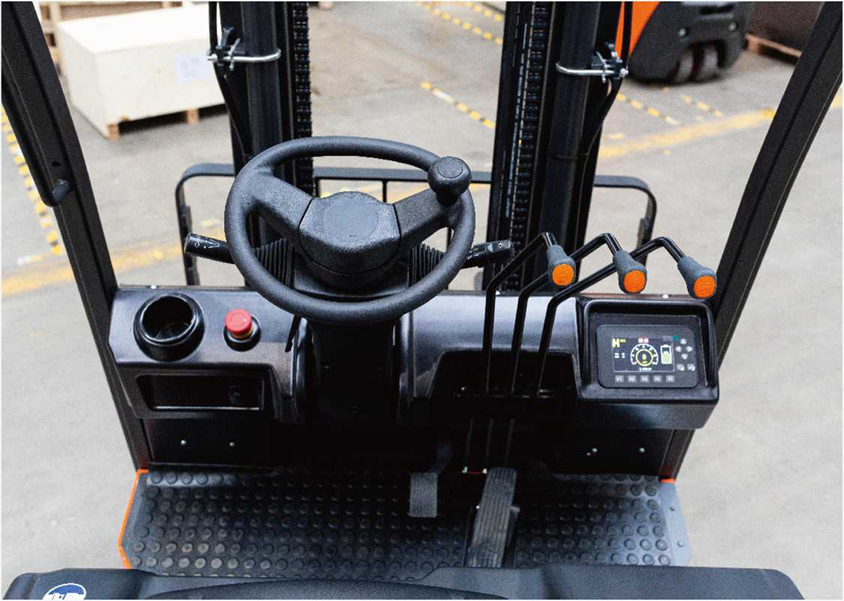
The driver's compartment is designed in line with best ergonomic practices: spacious cab, excellent visibility both directly through the boom and through its sides, right-hand hydraulic control (with both mechanical and mini-levers in the armrest), comfortable fully adjustable and shock-absorbing seat, low-lying boarding step, quiet operation, low vibration, USB sockets, a place for a drink and a binder holder, a sports steering wheel with an additional steering wheel („bulb“), grab handles for entry or reverse (with an additional acoustic signal), and a full set of lights at all times - all of which will keep you working comfortably and safely.
| Lots of small decisions that fit well together: | |
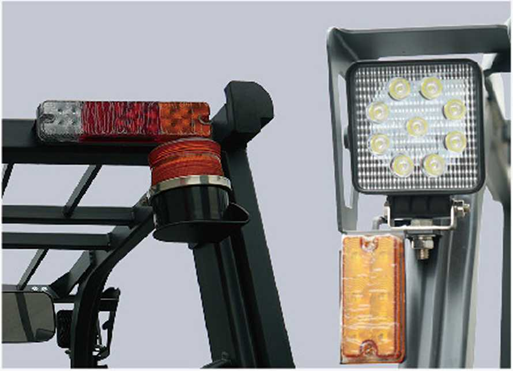 |
As standard, the loader is equipped with the following LED lights: headlights, front cornering lights, rear combination lights, warning lights. The lighting is bright and uses low energy and allows free operation at night. A reversing work lamp can be ordered as an option |
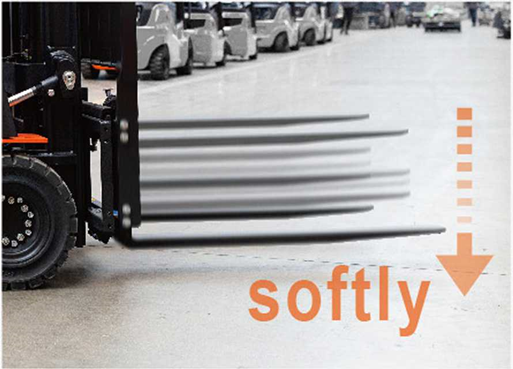 |
Just before the forks finish descending, the descent automatically slows down, protecting both the load from shocks and the floor surface from damage. |
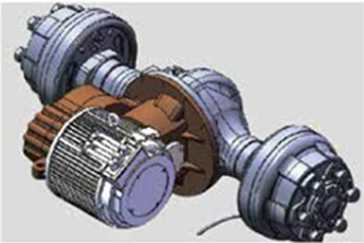 |
The front axle (also the driving and braking axle) has a 2-stage horizontally mounted reduction gear. The two-stage gearbox has a high transmission coefficient, so that the engine can run at higher speeds to get off the ground and then needs less energy to overcome inertia. On the other hand, the high gear ratio of the gearbox allows the traveling motor to run at higher speeds, whereas in the case of AC motors it is the case that the higher the speed at which the motor can run, the less energy it uses. |
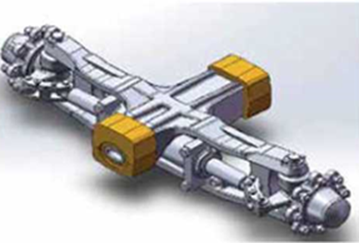 |
The rear axle and at the same time the steering axle have a vibration-absorbing design (mounted in the body on large rubber cushions), i.e. the use of curved flexible joints, which provides additional protection for the whole loader and extends the service life of the loader. |
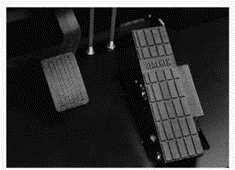 |
The forklift's driving and braking controls are also adapted from the automotive industry: in real terms, the controls are the same as those of a car with an automatic gearbox. The speed control is smooth and proportional, which undoubtedly adds to the comfort during operation. |
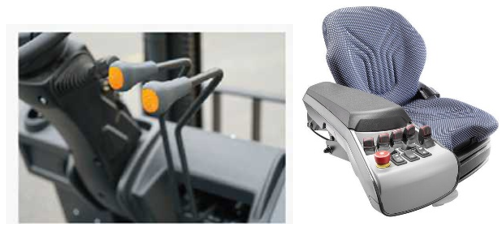 |
Hydraulic controls can be either mechanical levers or mini-levers in the armrest. If armrest mini-lever control is chosen, then the hydraulic components are from Bosch Rexroth, while the mini-levers and the fully shock-absorbing seat are from GRAMMER (Germany) |
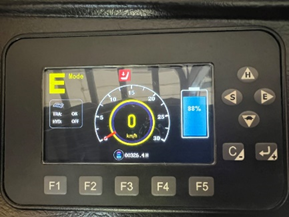 |
The Q-Series uses the standard CURTIS multi-function display. It allows you to select the required operating mode (E, S, H or slow (turtle)), displays the battery charge level, travel speed, moto hours, error messages, allows you to change other loader parameters, etc., etc. |
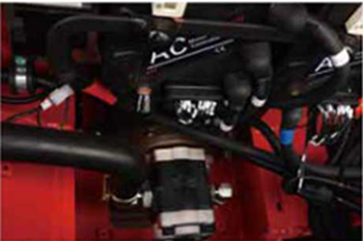 |
The hydraulic motor is mounted and well protected in the loader's body, high up and protected from direct moisture and dirt, so that the hydraulics will work reliably, even in continuous outdoor use |
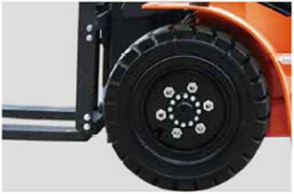 |
Large wheels are another of the Q-Series' distinctive advantages. The large diameter and wide profile wheels will handle the bumps in your yard and last even in winter conditions. |
Greener and safer lithium iron phosphate batteries
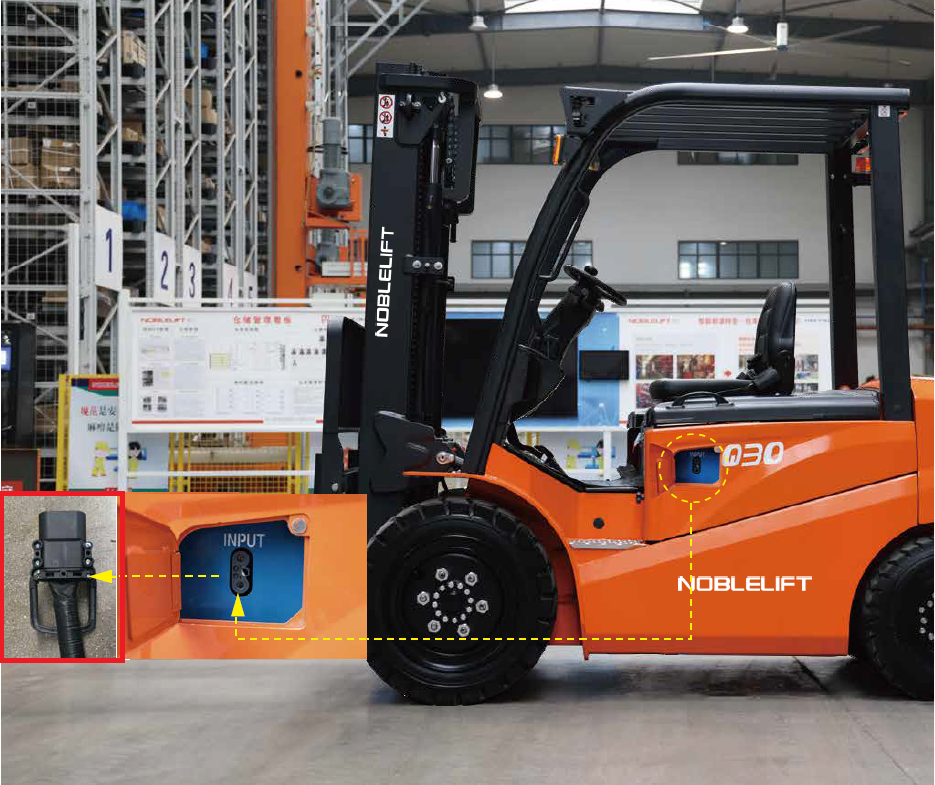
Charge the battery flexibly
Connectors with standard REMA (DIN) forks are used for fast battery charging. Connectors with automotive connectors can also be ordered if required. The unique fast charging function of the lithium iron phosphate battery makes it the ideal choice for work and multiple shifts. Compared to traditional lead-acid batteries, with longer working days or shift work, there is no need to change batteries between shifts or to have additional batteries and/or a dedicated charging room/area. Rapid charging during breaks between jobs or shift changes can significantly extend the continuous working time of the forklift. Moreover, if fast or partial charges are carried out correctly, they will not affect the life of the battery. In particular, the use of a lithium battery in the workplace offers more flexibility: it can be operated as a regular battery in the absence of overload, while the use of fast or partial recharges when necessary can significantly extend the continuous life of the battery.
If a lithium iron phosphate battery is chosen (as the Q-Series can also be equipped with lead acid batteries), it is particularly important for customers to know the basic rules for correct operation:
- Operating temperature from -200C to +500C. The protections start to activate at -150C and +350 C
- Theoretical storage temperature: -300C to +600C. In practice, we recommend that you do not keep a battery discharged below 70% at a negative temperature (i.e. not working).
- Permissible ambient temperature during charging +00 C, optimum +20-250C
- Recommended battery discharge level: 100% to 30%, allowable discharge up to 15% (discharging below this level triggers the protection)
- Optimal battery operating status is above 50%. Lithium batteries „like“ to operate in a high state of charge. Then its battery life is 2 - 3 times longer
- Partial charges: it is recommended to use them only when necessary and to always try to charge the battery above 50% before stopping the charge. Another way to proceed when it is seen that the battery will not be sufficient for all the work is to build a full or partial charge and not wait until the battery reaches 50% or 30%, but when there is a window of opportunity. For the specific batteries used in Noblelift it is „healthy“ to be better to be fully and continuously charged more often, but not more often.
- Standard charging. It is recommended to always fully charge the battery whenever possible, and to leave the charger on at least once every 2 weeks for a few hours after a full charge to allow the battery to fully balance.
- Fast charging is when a battery from 15% to 100% is charged in < 2 hours. If grit chargers are to be used, it is necessary to consider whether the power input will be sufficient. Even fast chargers have a balancing mode, whereby when the battery reaches 85% the charge is slowed down a bit, and when the battery reaches 95% the charge is slowed down even more for balancing purposes, so we always recommend to fully charge the battery for fast charging.
Environmentally friendly lithium iron phosphate batteries
- A lithium battery is more environmentally friendly. There is no acid evaporation, no smell and no pollution during the charging process. Lithium battery powered forklift trucks are relatively quiet and have zero carbon emissions. This makes lithium battery powered forklift trucks an ideal solution for industries concerned about the environment and high hygiene standards, such as food processing, chemical or pharmaceutical industries
- Each lithium battery only needs one battery for each forklift truck, and if there is a higher demand for continuous operation, the continuous battery life can be extended by a combination of fast and/or partial charges. Typically, lithium batteries have an average lifetime of three times longer than lead-acid batteries, following the recommendations for correct operation. On the other hand, working with a lithium battery is more convenient and easier as it does not need to be refilled with water or to have additional ventilation. All this leads to cost savings.
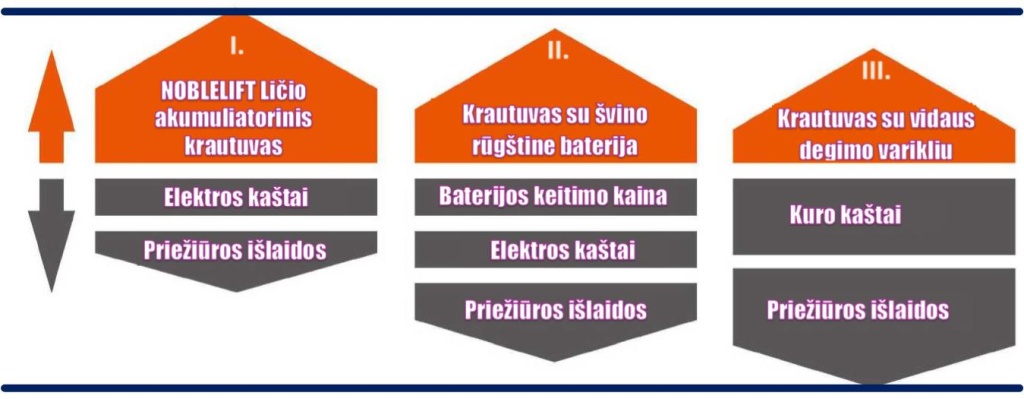
The eternal question - which type of forklift is the cheapest?
Comparing acquisition and operating costs, a forklift with a lithium battery can be more expensive than both a forklift with a simple acid battery and a forklift with an internal combustion engine (without artificially lowering the acquisition cost by opting for a lower capacity battery).
On the other hand, lithium battery forklifts can be up to 35% more energy efficient (because the battery itself is inherently much more efficient, and because the lithium battery forklift itself is optimised for energy savings), and they require significantly less maintenance, electricity as a fuel is cheaper than diesel or gas, which results in lithium battery forklifts being cheaper to operate than other types of forklifts (not even taking into account the fact that lithium battery forklifts do not require a separate charging room with forced ventilation):
Safety of forklift trucks with lithium batteries
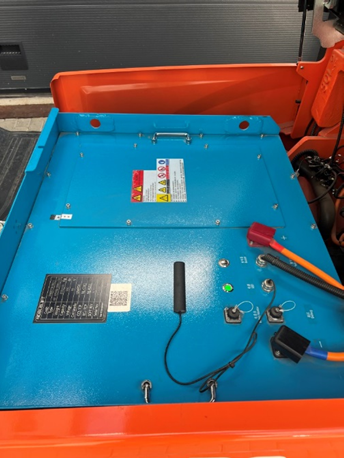
The lithium battery system consists of a high-density lithium iron phosphate battery with reliable safety, an intelligent battery management system (BMS), a thermal management system and an automotive-grade DC high-voltage management system. The BMS allows the lithium battery controller to communicate with the loader, the charger and the remote control services (*additional service) and to monitor in real time the lithium battery status, the loader operating status and the charging status in order to maximise lithium battery safety and reliability. On the other hand, most of the lithium batteries in Noblelift Q-Series forklifts already have a battery passport, which can be accessed by scanning the QR code on the battery. With the same QR code, the electronic SIM card (which is installed in most Noblelift lithium batteries) can be activated and Noblelfit then has remote access to the lithium battery and can perform factory diagnostics and change or update the battery's settings if required. The use of tested and certified components helps to ensure compliance with EU safety standards with all available supporting documentation as required by EU legislation.
Technical specification
| General parameters | 1,1 | Manufacturer | Noblellift | |
| 1,2 | Model | FE4P30Q | ||
| 1,3 | Type of power plant | electric | ||
| 1,4 | Method of management | seated | ||
| 1,5 | Lifting power | Q(kg) | 3000 | |
| 1,6 | Centre of gravity | C(mm) | 500 | |
| 1,8 | Lifting arm | x(mm) | 483 | |
| 1,9 | Wheel base | y(mm) | 1800 | |
| Weights | 2,1 | Own weight | kg | 4260 |
| 2,2 | Axle load front/rear (loaded) | kg | 6470/790 | |
| 2,3 | Axle load front/rear (unladen) | kg | 1860/2400 | |
| Tyres, chassis | 3,1 | Tyres (standard) | elastic non-lubricating | |
| 3,2 | Front tyres | 28×9-15 | ||
| 3,3 | Rear tyres | 6.50-10 | ||
| 3,5 | Number of wheels front/rear (X - drive wheels) | 2×/2 | ||
| 3,6 | Front track | b10(mm) | 1004 | |
| 3,7 | Rear track | b11(mm) | 982 | |
| Baseline measurements | 4,1 | Tilt of the jib | α/β(°) | 6/10 |
| 4,2 | Height of the lowered boom | h1(mm) | 2070 | |
| 4,3 | Free lifting | h2(mm) | 140 | |
| 4,4 | Lifting height | h3(mm) | 3000 | |
| 4,5 | Height of raised boom | h4(mm) | 4079 | |
| 4,7 | Height of protective frame | h6(mm) | 2150 | |
| 4,8 | Seat height | h7(mm) | 1130 | |
| 4,12 | Height of the towing pin | h10(mm) | 580 | |
| 4,19 | Total length | l1(mm) | 3813 | |
| 4.20 | Length without forks | l2(mm) | 2743 | |
| 4,21 | Overall width (frame/tyres) | b1(mm) | 1226 | |
| 4,22 | Fork dimensions | a/p/i(mm) | 45/125/1220 | |
| 4,24 | Width of fork-lift wheelchair | b3(mm) | 1100 | |
| 4,31 | A missile under the arrow | m1(mm) | 135 | |
| 4,32 | Clearance at the centre of the wheel base | m2(mm) | 150 | |
| 4,33 | Working corridor with pallet 1000×1200 mm taken across | Ast(mm) | 4083 | |
| 4,34 | Working corridor with pallet 800×1200 mm taken lengthways | Ast(mm) | 4283 | |
| 4,35 | Turning radius | Wa(mm) | 2400 | |
| Operating parameters | 5,1 | Running speed, loaded/empty | km/h | 14/15 |
| 5,2 | Lifting speed, loaded/empty | m/s | 0.3/0.4 | |
| 5,3 | Lowering speed, loaded/empty | m/s | <0.6 | |
| 5,5 | Maximum thrust developed, loaded/empty | N | 14000/15000 | |
| 5,7 | Maximum climbable hill, loaded/empty | % | 15/20 | |
| 5,10 | Service brakes | Hydraulic | ||
| Engines and drives | 6,1 | Running engine power S2, 60 min | kW | 16 |
| 6,2 | Lifting motor power S3, 15 min | kW | 16 | |
| 6,3 | Battery | Lion | ||
| 6,4 | Battery voltage and capacity | V/Ah | 76.8/277 | |
| 6,5 | Battery weight | kg | 215 | |
| Battery dimensions | mm | 770/650/680 | ||
| Others | 8,1 | Type of drive for the driving motor | AC | |
| 8,2 | Hydraulics working pressure | Mpa | 17,5 | |
| 8,3 | Hydraulic tank capacity | l/min | 36 | |
| 8,4 | Noise level in the operator's ear according to EN 12053 | dB(A) | 74 |