Aprašymas
Why choose ENERSYS batteries and key performance tips
- First of all, unique technologies such as Perfect Plus (Energy Plus), WaterLess, Ironclad and others.
- As the largest battery manufacturer, ENERSYS can afford to use the most advanced manufacturing technologies, which, above all, ensure the longevity of the battery
- Finally, the commissioning of batteries is very important, i.e. whether and, if so, how the battery has been factory calibrated. Forming)
The production of liquid electrolyte traction batteries has been a standardised process in principle for probably more than 50 years. However, the statement that all batteries are produced with the same equipment is only part of the truth, as different stages of battery production can vary from manufacturer to manufacturer, with radical consequences for the battery's lifetime, both in terms of duration and performance (such as the ability to maintain the voltage in the nominal range, heat-up, water consumption, the ability to accept a full or effective charge, etc.).
The main component of all batteries, which is subject to even 85% of natural wear and tear, is the positive plate - which is why it is made in a tube shape, to increase the contact surface area, while at the same time being able to withstand the higher currents flowing through it. The downside of the tubular positive plate is its increased susceptibility to destructive oxidation (corrosion), and only the most serious manufacturers are taking technological measures to combat this process and thus prolong the service life (because it costs money and the economies of scale are needed to keep the battery price competitive). Each manufacturer states that its battery is designed to last up to 1500 charge/discharge cycles, but in real life only a few manufacturers' batteries can achieve this number of cycles while keeping the battery parameters within the norm.
ENERSYS uses the following technological measures to increase the corrosion resistance of the positive plate
The most sensitive issue with regard to the positive plate is the filling of the plate (i.e. the tubes or tubes) with lead dioxide (i.e. the active mass). There are different ways of doing this. The cheapest and most common way is gravity - where a liquid active mass is produced and simply poured into the tube. A more serious approach is to pressurise that liquid active mass. However, the most technologically advanced, the most reliable and at the same time the most expensive method is the one used by ENERSYS - the tubes are filled with dry active mass (i.e. its „flour”) and then the tubes are well vibrated and the process is repeated until the tube is completely filled with the active mass. An illustration of these different processes is given below - what the active mass looks like when viewed through an electron microscope:
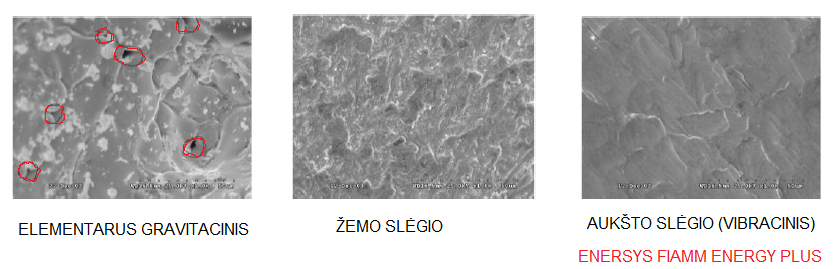
Gravity-filled positive plates are heterogeneous - they contain gaps (holes) that become corrosion hotspots quite quickly and therefore the battery has a naturally shorter lifetime because the active mass is used up faster. Low-pressure plates usually do not have obvious holes, but their surface is not smooth enough (which gives less resistance to corrosion - as any sharp edges or indentations start to corrode over time). In contrast, high-pressure or vibratory type plates have as smooth a surface as is technologically possible and, most importantly, the highest density (and thus quantity) of active mass. And from here 3 things follow: the physical surface properties of the plate make it more active against corrosion and with more active mass, the battery lasts longer (because in simple terms, „it takes longer for the acid to eat up all of the active mass because there is simply more of it”. Last but not least, the high density of the active mass, together with the chemical additives used by ENERSYS, not only increases the corrosion resistance but also increases the operating (nominal) voltage of the battery.
Another technological factor that determines the longevity of a battery is how the battery cells are activated. The most common way is to simply stack the cells and charge, charge and charge again. This is a classic, but it has its drawbacks: activating batteries in this way makes it easy to overheat the cells (and heat has an exponential destructive effect on the active mass), and it is difficult to control the capacitance generated by each cell. ENERSYS has a different approach here: the manufacturing process is such that each cell is activated individually, not only by charging it but also by constantly ensuring the circulation of the electrolyte. As a result, the cells do not overheat and the maximum amount of capacity (Ah) is activated. The technological apparatus that activates the cells is practically a unique device, which (if the manufacturer has one) is a unique engineering product, incorporating all the manufacturer's experience and is usually the most expensive component of the plant. Again, for a manufacturer to be able to provide a competitive battery price using this type of device, it needs to be large in order to reduce the cost of batteries through economies of scale. In the case of ENERSYS, all the manufacturing steps described are called PERFECT PLUS or ENERGY PLUS and all batteries produced by ENERSYS have this technology as standard (e.g. in the case of Water Less or Ironclad, it is not described separately but is used anyway).
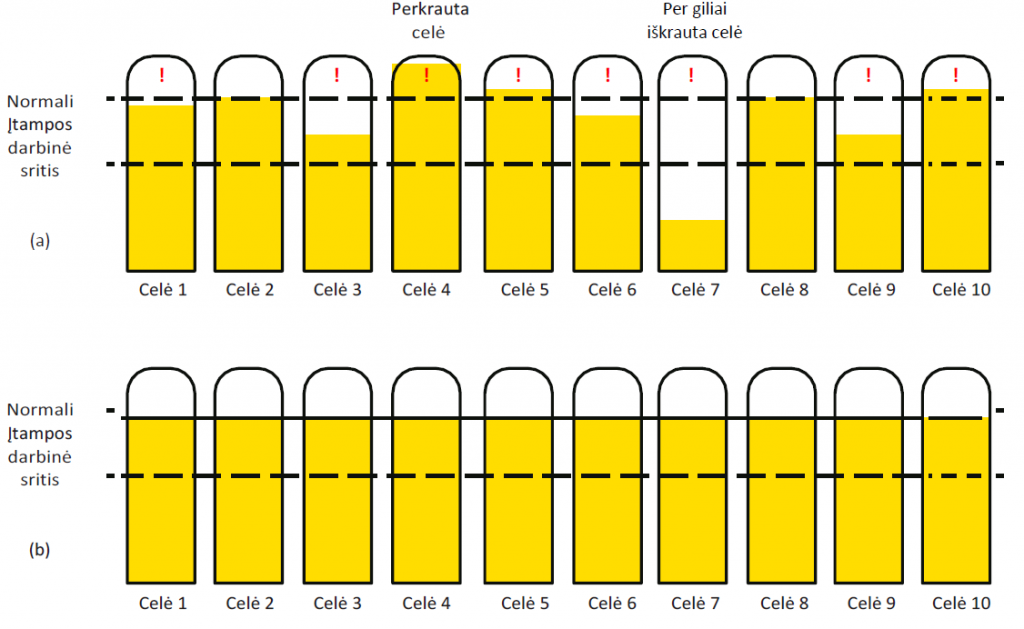
Uniform capacity, electrolyte level and charge level of the individual cells are essential parameters to ensure the longevity of the battery: for the battery to function as a single system, and not as a number of small batteries of 2V connected in series, it is essential that all cells are charged and discharged in the same way, and that the same electrolyte level is present in each cell. The electrolyte density is directly related to the cell voltage. If the electrolyte levels or electrolyte densities vary, the cells will charge and discharge differently when working in series and the longer this process continues, the sooner the battery will end its life as the positive plate of the cells that are continuously discharged too deeply will decay and those that are not fully charged on a regular basis will simply sulphatise and lose the ability to store Ah:
Y
There are different ways to tackle it. It all starts with the purchase of a new battery: never buy a new battery after it has been re-equipped with individual cells, as there will be a small amount of cell dispersion from day one and this will only increase over time; make sure that the manufacturer has calibrated the assembled battery. During this process, ENERSYS uses a robot to check the electrolyte level, density and capacity of the individual cells that have already been put in the box, so that all the cells work as a single system, rather than as individual small batteries stacked together in a single pile. It is important to note here that this process is usually only fully carried out by the battery manufacturers themselves, whereas there are many new battery suppliers who buy cells from different manufacturers and put them into new boxes themselves, thus ensuring a fast delivery time and being cheaper than fully original batteries. To avoid cell imbalance during operation, it is necessary to refill the batteries regularly with water and to carry out an equilibration charge every week (every 2, 3 or 4 weeks depending on the manufacturer and the charger used) and to make sure that the electrolyte density is the same in all cells (within 0.02). If the density is spread over a wider range and has not recovered after successive equilibration charges, the battery must be taken to a workshop for repair. If no cell replacement is required, such repairs are usually cost-effective, take up to 3 working days and significantly extend the life of the battery.
How does the battery affect the wear and tear of appliances?
When operating the battery, it is vital to monitor the condition of the battery (in particular to ensure that the battery is balanced - with proper charging and topping up with water) and that it has not lost more than 50% of its initial capacity. Because only such a battery will be able to maintain the operating voltage in the nominal range. Because if the battery is no longer able to maintain the nominal operating voltage (e.g. due to cell imbalance, sulphatisation, cells with degraded active mass, etc., etc.) and if the same work is required (i.e. when the applied power is P = CONST and P = U (voltage) x I (current)), then a current starts to rise as the voltage drops. This would be all well and good if it were not for the dependence of heat release on current:
Q (heat) = I Current2 x tTime x Rresistor
In other words, all it takes is to increase the current by at least 2A more than allowed and everything heats up 4 times more than it should, etc. And heat is a major factor in the wear and tear of the internal components of machinery, especially components such as electric gears or brush motors. It is therefore very important to check the condition of the battery regularly and not to delay the timely replacement of a worn-out battery, as an old battery will usually cause much more damage than a timely replacement.